
Many business owners approach purchasing insurance the same way they buy their personal coverage—by calling multiple agents to “shop around” for the best price. While that makes sense for personal policies, it can actually work against you when it comes to business insurance.
The Problem: How Business Insurance Works Differently
When you buy personal insurance, each company you contact provides a quote independently. The more quotes you get, the more likely you are to find a lower premium. Your rates are fairly similar across companies. You can get discounts by bundling policies or qualifying for standard discounts for auto and home policies.
Business insurance doesn’t work the same way. Commercial insurance companies operate through brokers who gather information about your organization and then have to paint a picture of your company to underwriters, who then give pricing based on a variety of factors.
There are three key differences with this process that you must know in order to purchase commercial insurance wisely:
- Insurance companies only work with one broker at a time. Once an insurance company receives a submission from a broker, it’s “blocked” from working with anyone else for that same client, even if the 2nd broker knows more about your company and has been working with you longer.
- Not every broker has access to the same insurance markets. Some agents represent more companies than others. Additionally, some agents or agencies may have better relationships with a given company than others, allowing them to negotiate lower rates.
- Underwriters price insurance based on the information they receive. If the submission they receive from your broker does not differentiate you in any way from other companies in your industry, then you will likely be priced the same as all the others. Additionally, when multiple brokers submit inconsistent or incomplete details about your business, it can cause confusion and make your business appear less attractive as a risk, resulting in higher rates. Underwriters have discretionary credits they can give to the clients that represent the best risks. These savings are not easily accessed and are only given to the safest companies.
So what is the result of ignoring these concepts?
The very process meant to find you the lowest insurance rates can make you look like a higher risk, pushing your costs higher instead.
An Example: How Multiple Brokers Can Cost You More
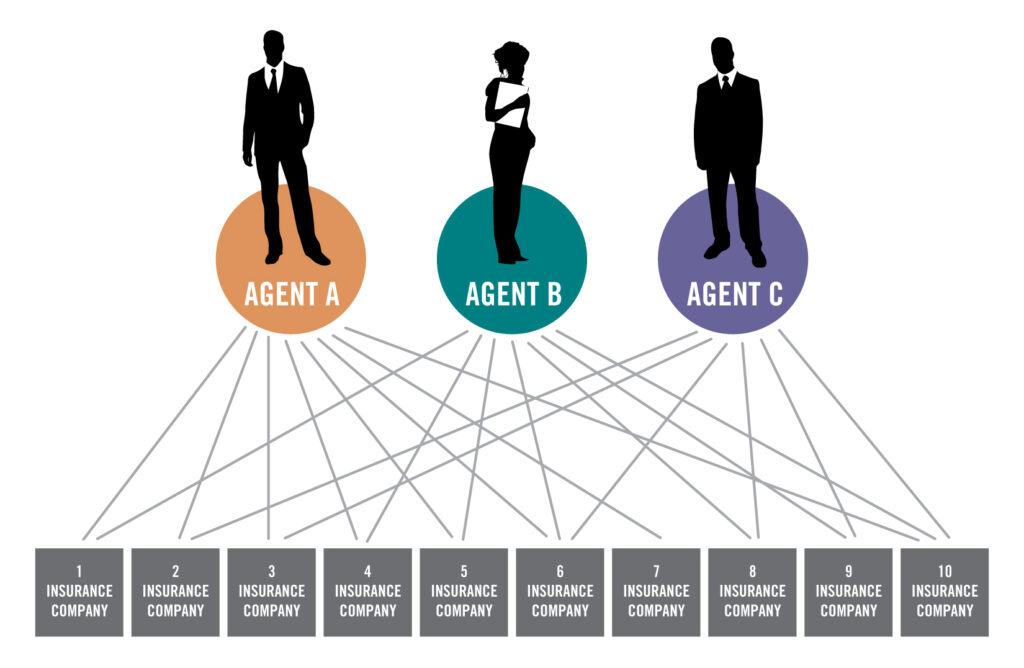
Imagine you give three agents permission to quote your business. Each reaches out to the same pool of insurance companies. See the illustration below; does this look like a scenario that will benefit your business? No, it creates uncertainty and confusion. When underwriters receive different or conflicting information about your business—sometimes even small details like payroll, revenue, or safety procedures—it erodes their confidence in your organization. Without clarity, they assume greater risk. And when underwriters sense risk, they protect themselves with higher premiums or less favorable terms.
Additionally, underwriters know that if multiple brokers are competing for your account, the chances of their quote being chosen drop. That discourages them from offering their most competitive pricing.
In the end, you don’t just lose time, you lose money…year after year.
Best Practices for Buying Business Insurance
The solution isn’t more quotes—it’s better representation. The smartest business owners:
- Choose one trusted agent who has access to a wide range of companies and a strong reputation with underwriters. If your agent does not take time to discuss your market strategy throughout the year and does not review how they will approach underwriters, there is likely savings being left on the table.
- Control the narrative: Invest time upfront to help your agent thoroughly understand your business and ensure that your agent communicates that information effectively to the insurance marketplace. The more accurately your story is told to underwriters, the better your pricing and coverage will be.
The Bottom Line
Buying business insurance the same way you buy personal insurance can backfire. Multiple agents and mixed submissions create confusion, weaken your negotiating position, and can lead to higher premiums.
By working exclusively with one trusted agent who knows your business inside and out, and controlling the narrative told to underwriters about your business, you will be able to have peace of mind that you will secure the best possible rates year after year.